Hedgerow, Field Edge or Orchard Path? Choosing a Country Walk
Choosing a country walk by route type helps match your available time and curiosity to close hedgerow details, open field views or orchard paths.
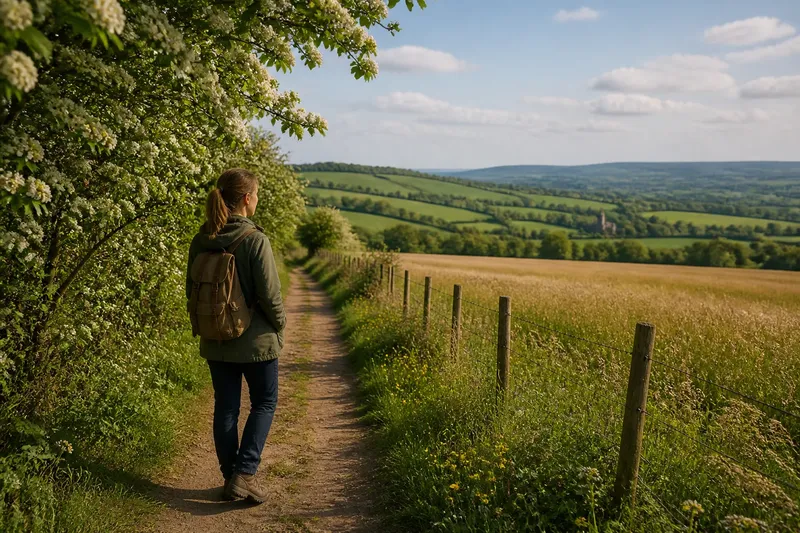
The common mistake when choosing a country walk is to pick the prettiest name on a map and assume the route will suit the afternoon. A hedgerow, field edge and orchard path offer different kinds of attention: overlook that, and a short outing can feel hurried or an easy stroll oddly empty. Choosing a country walk begins with one plain question: do you want to notice what is close, look far across the land, or follow a path shaped by trees?
1. Choose a hedgerow for close looking
A hedgerow walk keeps the eye near. Hawthorn, hazel, bramble and dog rose gather along the boundary, with gaps that reveal glimpses of a lane, pasture or cottage garden. The view rarely opens all at once; it arrives in fragments, which makes this route satisfying when your curiosity is more about small changes than a grand prospect.
The pace tends to be unhurried. A leaf caught in a thorn, a wren slipping into cover or a patch of moss on a gatepost can hold your attention without requiring a planned destination. In spring, fresh growth gives the boundary a soft, layered look. Later in the year, berries and seed heads bring colour and texture, though what appears depends on the place and season.
Choose a hedgerow when you have enough time to walk attentively but do not need a broad view to feel that you have gone somewhere. It is also a good option for a familiar loop: a route you know can still offer new details as growth, light and weather alter the edges.
- Best for: close observation, a gentle pace and changing seasonal detail.
- Look for: a clear public path, varied hedges and occasional openings onto fields or lanes.
- Less suited to: anyone hoping for uninterrupted views or a direct, brisk line across open country.
Stay on the path and avoid reaching into dense growth. Boundaries can conceal wire, nettles or nesting birds, and a hedge is not an invitation to pass through a gap into a field.
2. Choose a field edge for distance
A field-edge route trades the hedge’s close detail for a wider frame. The path may run alongside pasture or arable ground, letting you follow the line of a slope, a stand of trees or a distant church tower. If your mind feels crowded, that outward view can give the walk a calmer rhythm: the eye has room to travel, and your attention is less likely to stop at every leaf.
Field edges are often best when the weather is clear enough to make distance legible. In low cloud, the same route may feel quieter and more enclosed, with the near field doing most of the work. Wind is more noticeable here than under a hedge, so clothing that seemed unnecessary beside the car can matter once you leave the shelter of trees.
Choose this route when you want to keep moving and enjoy a sequence of changing views. It can also suit someone who likes to orient themselves by landmarks: a bend in the field, a line of mature oaks, or the point where a track meets a lane. The path’s appeal lies in watching those features shift as you walk, not in reaching a particular one as quickly as possible.
- Best for: open horizons, steady walking and noticing how land rises or falls.
- Look for: a route with clear public access and a return path that does not require guessing across farmland.
- Less suited to: a hot, exposed afternoon or a day when you would rather stop often in shelter.
Keep to marked paths, close gates behind you and give livestock plenty of space. If a route is unclear, use the local rights-of-way map or ask a landowner or local authority about access rather than assuming that a field track is public.
3. Choose an orchard path for pattern
An orchard path offers a more ordered kind of countryside walk. Rows of trees make repeated lines, and the view changes as the path passes between trunks, branches and patches of grass. That pattern can be pleasing in itself, especially when you want a modest outing with something to notice but no need to cover much ground.
The interest changes with the orchard’s cycle. Blossom makes the branches conspicuous; later, leaves and fruit alter the colour and weight of the rows. In winter, the bare structure becomes easier to read. These are not merely seasonal decorations: each stage changes the way the path feels, from airy and open to shaded and enclosed.
An orchard is not always open for public walking, even if it appears on a map or is visible from a lane. Some are working land, private gardens or part of a farm business. Choose one only where access is clearly permitted, and respect signs, gates and any request to keep away from fruit or equipment. The orchard’s calm appearance does not make it a public park.
- Best for: a contained walk, repeated visual patterns and seasonal changes in trees.
- Look for: an established public path or a site that explicitly welcomes visitors.
- Less suited to: a long wandering route unless the orchard connects clearly with other paths.
4. Match the route to your time
Time is not only a matter of distance. A close-detail route invites pauses; a broad field edge can carry a steady pace; an orchard may feel complete after a short circuit. Before setting out, decide how much time you have for walking and how much you want to leave for stopping, looking or sitting. That small distinction is more useful than choosing a route by its name alone.
Say you have a free hour before supper and want to notice something beyond the lane. You could choose a hedgerow loop with a few open views, allowing for brief stops at a gate or patch of wildflowers. If you have the same hour but want to stretch your legs continuously, a field-edge route may suit better; if there is a permitted orchard path nearby and you are curious about its trees, that could provide a compact outing. The choice follows the shape of the hour, not a promise about how far you will get.
For an unfamiliar route, check a local map before leaving and identify a turning point or return path. Leave room for a slow patch, a muddy stretch or a gate that needs attention. Trying to fit a long loop into a narrow window tends to turn observation into clock-watching.
5. Let curiosity set the pace
Each route rewards a different question. Along a hedge, ask what is growing at the boundary and where small animals might find cover. At a field edge, notice how the land’s shape directs water, tracks or the view. In an orchard, look at the spacing and form of the trees, and how light falls between the rows. A simple question keeps the walk engaged without turning it into a task.
There is no need to carry a camera, notebook or plant guide every time. A phone can help with maps, but constant checking interrupts the very attention a country walk offers. A small field guide can be useful if you enjoy identification; it is not worth the effort to name every plant or bird before you have learned to notice where it is. Looking carefully is a sufficient purpose.
For a mixed afternoon, combine route types only when the paths join naturally and public access is clear. A short stretch beside a hedge can lead to an open field edge, or an orchard path may meet a village lane. Avoid making a circuit complicated simply to collect all three kinds of scenery. The value of the walk comes from the quality of attention, not the number of boundaries crossed.
Which country walk suits you?
Which route is best for a short walk?
An orchard path or a compact hedgerow loop can suit a short outing, provided the path is open to the public. Choose the orchard for a contained, patterned view, and the hedge for more small details along the way.
Which route offers the widest views?
A field edge usually gives the clearest sense of distance, especially where the land is open and the route follows a ridge or slope. A hedge-lined walk may include outlooks, but those views tend to appear in shorter glimpses.
Which walk is best for noticing wildlife?
Hedgerows offer cover and a close boundary where birds and insects may be visible, while field edges can reveal animals in open ground. Move quietly, keep your distance and let what you see remain undisturbed.
Can I walk through a working orchard?
Only if access is clearly allowed, such as on a signed public footpath or at a site that welcomes visitors. Do not enter a private orchard or pick fruit without permission.
Choose by the day
Choosing a country walk becomes easier when you begin with the day’s mood rather than a claim about which route is best. Take the hedgerow for close attention, the field edge for distance, or the orchard path for ordered seasonal detail. If the weather shifts or your time changes, a familiar lane or short public loop is often a wiser choice than pressing on to a more ambitious destination. The most rewarding walk is the one that leaves enough room to notice what is actually there.