Before the Almanac: How Country People Kept the Year in Mind
Before the almanac, seasonal sayings and household calendars helped country people organise work, keep appointments and distinguish local observation from weather prediction.
The common mistake in reading country sayings is to treat them as forecasts; the cost is missing the practical reminder carried in the phrase. Before the almanac, seasonal sayings, household calendars and remembered signs offered different ways to keep the year in view, though their importance varied from place to place and household to household.
A saying might prompt someone to inspect a hedge, while a calendar marked a fair or a rent day. A familiar change in the landscape could suggest that a task was approaching. These were not interchangeable clocks: one could preserve a hint about work, another record a fixed appointment, and another draw attention to what was happening locally.
Sayings and forecasts
Seasonal sayings are often repeated without their original setting. A phrase about a cold spring, a wet harvest or a particular bird can sound like a promise about the weather to come. It may instead be a compact memory aid, connecting an observation with a task, a risk or a customary expectation.
Confusing a reminder with a prediction gives a saying more authority than its wording can support. It cannot account for a late frost, a dry spell or the difference between a sheltered valley and an exposed upland. Soil, altitude and drainage can also make the same seasonal cue relevant in different ways, even within one parish.
Ask what a saying was meant to prompt. It might suggest watching a crop, checking a boundary, preparing a tool or anticipating a communal event. Keep the practical prompt if it suits the work; do not let a rhyme make the decision for you. It is not worth arguing over exact wording when its local meaning has been lost: an explanation of what to notice is more useful than a polished version collected elsewhere.
Reading local signs
The first blossom on a familiar tree, returning birds or the state of a lane can all seem to announce a season. But a sign may appear early or late, and it does not tell you whether the ground or the work is ready. A warm spell, for instance, may bring a plant on while the soil remains unsuitable for planting.
Rather than treating one sign as an instruction, compare it with the conditions that matter to the task. A flowering hedge may be a reason to inspect the garden, not to change the household routine automatically. That distinction keeps attention on the actual field, garden, lane or animals instead of on a calendar cue alone.
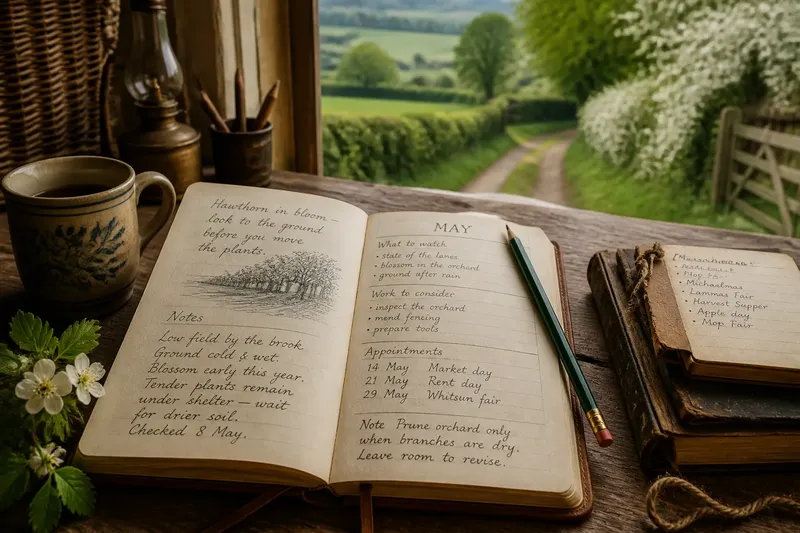
Say you live beside a low, damp field, and a saying links the first hawthorn blossom with moving tender plants outdoors. The blossom appears, but the ground is still cold and waterlogged. You note the flowering, inspect the soil and leave the plants sheltered; the resulting decision is to wait for suitable ground rather than follow the saying’s timing. This invented situation shows how a remembered sign can inform attention without settling the practical question.
Household calendars
A household calendar could contain market days, local fairs, visits, rent dates, church observances and recurring domestic obligations. Some entries marked fixed appointments; others pointed towards work whose timing depended on weather, daylight or help from neighbours.
A bare note such as “hay” leaves too much unsaid. Does it mean checking the forecast, arranging help or making room in a shed? A seasonal entry is more useful when it records what needs watching and what decision follows. For instance, “inspect the orchard after blossom; postpone pruning if the branches are wet” gives a reader a cue and a condition to act on.
Keep fixed appointments distinct from flexible prompts, either in separate parts of a notebook or through clear labels. Leave room to revise seasonal notes: a pencil entry can show that a change applied to one particular year, rather than suggesting that it was always the household’s rule.
Custom and necessity
A fair, seasonal meal, communal task or local observance could bring people together at a familiar point in the year. In some places, customs may also have helped organise cooperation. The reason for a practice can become less clear over time, leaving its timing mistaken for a rule about nature.
Separate the social purpose from the practical one. An occasion might offer a convenient time to meet, trade or settle arrangements, but it did not make crops ready or settle what the weather would do. A task, in turn, might depend on local conditions even when custom gave it a familiar name or place in the year.
Ask whether a practice fixes a date, brings people together, marks a seasonal change or offers advice about work. It may do several of these things. Identifying its purpose helps distinguish a social marker from guidance about a practical task. If an obligation depends on a current local calendar or arrangement, check the relevant notice or ask the person responsible rather than relying on a saying from somewhere else.
Questions about almanacs?
What did a seasonal saying do?
It could compress a remembered observation into a phrase that was easy to repeat. Read it as a prompt to notice or prepare unless its local use indicates something more specific.
Could a natural sign set an exact date?
A sign alone cannot settle a date for action when local weather and conditions vary. Use it to focus attention on the relevant task, then make the decision from what you can observe.
How should a household record a changing custom?
Write down what happened, where it applied and whether it was a fixed appointment or a flexible seasonal practice. Include the reason for the entry so a later reader can see what may be adapted.
Why keep an almanac if people remembered signs?
An almanac could gather dates and general seasonal guidance, while memory supplied local detail and immediate observation. They could serve different purposes without either making the other unnecessary.
Keeping time legible
A modest household notebook can pair a familiar saying with the observation behind it, then leave space for what happened locally. Record the condition of a path, the state of a hedge or why a task was postponed. The point is not to make a grand record of the countryside, but to leave enough context for a later decision to make sense.
Seasonal sayings, calendars and remembered signs each offer a different kind of cue. The phrase before the almanac is a reminder that keeping the year in mind could involve noticing, writing things down and sharing local knowledge. When an old saying turns up, ask what it helped someone remember—and check whether that observation still fits the place in front of you.